Posted by barb on Mar 29, 2005 in
Science Musings Last time I was on the Ask a High Energy Astronomer hotseat, I stumbled across this article: The “Big Bang” is Just Religion Disguised as Science [The article moved or is gone – Jan 2014]. Wow. Fortunately, the article is difficult to find if you go straight to the What Really Happened page, but there you’ll find some other wacked-out theories (I’m assuming, based on the headlines — I didn’t actually read through anything).
This particular article starts out with a long introduction about how the geocentric model of the Universe was based on religion, and how later generations clung to the model because it served the agenda of the Church. Okay. A bit clunky, and rambling, but not entirely inaccurate.
Then the article gets weird. It brings up the discovery by Hubble that all galaxies appear to be receding from us. The article states:
Religious circles embraced the idea of an expanding universe because for the universe to be expanding, then at some point in the past it had to originate from a single point, called the “Big Bang”. The “Big Bang” coincided nicely with religious doctrine and just as had been the case with epicycles (and despite the embarrassment thereof) religious institutions sought to encourage this new model of the universe over all others, including the then prevalent “steady state” theory.
Huh? I’m not sure which religion the author is from, but most of the ones I’m familiar with (namely, the Protestant Christian ones) hate the idea of the Big Bang. They contend that the Universe cannot be as old as Big Bang cosmology indicates, and blast anyone who dares promote the Big Bang. The debate has not yet reached the level of the evolution controversy, but it’s just a matter of time.
The article then goes into more current work on Big Bang cosmology:
An attempt was made to prove the Big Bang by searching for the “Cosmic Background Radiation”, the presumed energy echo from the primordial explosion. and indeed a radio noise signal was picked up.
Yes, the CMB (cosmic microwave background) is viewed as a large piece of evidence supporting the Big Bang theory. However, the CMB was discovered more by accident than as a search for evidence to back up the BB.
But just as the theory of epicycles did not accurately predict the observed motion of the planets, the Big Bang Theory turned out to be less than accurate about the radiation signal detected in space. When the satellite COBE was sent up to analyze the Cosmic Background Radiation, it discovered instead of the smooth featureless glow predicted by the cosmologists a highly complex and detailed structure.
Actually when the first COBE results were posted, the astronomers were impressed by how smooth the results were, but were also a bit worried that it was too smooth. After longer exposures, COBE finally showed the complexities in structure that had, indeed, been expected.
The article finally gets to the point it wants to make. It presents the theory that the redshifts observed for distant galaxies can be caused by the remnant of a nearby supernova — that there is an old remnant of a planetary nebula Earth is sitting in.
The evidence presented in the article are scant
- We’re made of heavy elements — Okay, that’s right, but they came from generations of stars successively enriching the interstellar medium. But, we are, in fact, sitting in the “Local Bubble”, which is likely due to an ancient, relatively nearby supernova. But, there’s no evidence of a remnant planetary nebula, and astronomers have known about this “Local Bubble” for a while now.
- Redshifts in some studies of distant galaxies show that they are quantized — This is not directly supported by the idea that there was a nearby supernova, but was “quite possibly triggered” by it. By what method? Besides, redshift is not the only way that astronomers measure distances — it’s the one commonly used for the furthest objects, but other things, like Type Ia Supernovae confirm the idea of redshift as distance indicators (at least, to a certain distance)
- Um..that seems to be it.
The author seems to want to “shame” astronomers into considering his theory because apparently we’re clinging to a “religious view” of the Universe. I’m sorry to inform him that it’s not going to work that way. For astronomers to reexamine a well-established (and well-supported, for that matter) theory, there needs to be compelling new evidence that has been well-tested (and well-established). The first response to the initial evidence for “dark energy” was skepticism. Since then, there have been numerous studies that have confirmed the original results — only then did astronomers and cosmologists start to reformulate their view of the Universe.
Tags: rant, science
Posted by barb on Mar 27, 2005 in
Random Thoughts For Easter, a few Peeps links:
Enjoy! And Happy Easter!
[Update: By the way, that link for the Peeps contest was from last year’s contest. They held another contest this year, and you can check out the related article (you might need to register) and slideshow of winners My favorite of the new bunch is #13, “Peeps Attacks”.]
Tags: linkalicious
Posted by barb on Mar 26, 2005 in
Movies 4/5 stars
Born Into Brothels is a documentary about the children living in the red-light district in Calcutta. Zana Briski lived in the red-light district on and off for several years, getting herself into a position to photograph some of the goings-on in the lives of the prostitutes. But the first thing that struck her, when she first arrived, was all the children. These children have few prospects for rising above their mothers’ stations, particularly the girls.
Briski decided to teach some of the children photography. As she got to know the children, she worked to get some of them out of the brothels and into boarding schools (to get them out of the red-light district altogether). But it was exceedingly difficult — most of the boarding schools would not take children whose parents were criminals. To help pay for the schooling, Briski helped to arrange an auction of the kids’ photographs.
The film is not nearly as depressing as I had expected it to be. Much of the film focuses on the children and their photography. What really struck me was that there were fathers in some of the children’s lives. Fathers. In the red-light district. They were useless, for the most part, but the fact that they were there at all surprised me.
Definately recommended. Also check out Kids with Cameras — the organizatio aimed at teaching kids around the world the art of photography.
Tags: reviews
Posted by barb on Mar 25, 2005 in
Random Thoughts On I-Street near GWU.
20-something woman in a very pink, short over-coat with a matching pink umbrella talking on her cell phone: “A lady in the elevator at Saks said I looked like a giant Easter bunny…”
Tags: overheard
Posted by barb on Mar 24, 2005 in
Science Musings While answering questions this week for Ask a High Energy Astronomer, I came across a set of homework solutions for an astronomy class at a community college. I skimmed over it, and found the following answer to a question about the advantages of putting telescopes on the moon:
Perhaps the greatest advantage of observing from a place that has no atmosphere is being able to observe every conceivable wavelength of electromagnetic radiation equally well. Significant amounts of visible light waves and radio waves are able to pass completely through Earth’s atmosphere, but very little else can. From the Moon, or from space, the same telescope could be equipped to detect gamma rays, X-rays, ultraviolet, visible, infrared, and radio. From the surface of the Earth, a telescope is mostly limited to observing visible and radio wavelengths.
[Emphasis is mine]
While the main emphasis of the answer is correct — since Earth’s atmosphere absorbs certain wavelengths, if we put a telescope where there is little/no atmosphere, we can observe all wavelengths — the statement that any given telescope could be equipped to observe any wavelength is absolutely misleading.
X-ray telescopes work quite differently from visible telescopes, since X-rays tend to penetrate mirrors rather than reflect. In fact, X-rays only reflect at “grazing incidence”, so X-ray telescopes must be constructed with mirror surfaces nearly parallel to incoming light, rather than perpendicular as in optical telescopes. (Check out this page for more on X-ray telescopes.)
In addition, and perhaps more importantly, gamma-rays cannot be focused with current technology. Gamma-ray telescopes do not use reflection-optics for this reason, and generally use some other kind of technology to determine direction-of-origin, including optical masks and silicon-strip detectors. (Check out this page for more on gamma-ray telescopes.)
So, while it would absolutely be possible to observe all wavelengths from the Moon’s surface, due to its lack of atmosphere, it is not possible to use the same telescope to observe all of those wavelengths.
Tags: science
Posted by barb on Mar 23, 2005 in
Random Thoughts I was in another building on campus for a meeting this afternoon and saw this sign in the ladies’ room:
When having parties or celebrations in this room, please remember to clean up. Melwood is not responsible for that.
Who, exactly, is going to use the ladies’ room for a party or celebration?
Tags: oddness
Posted by barb on Mar 21, 2005 in
Random Thoughts The last four or five times that I’ve parked my car in a lot (i.e. not just outside the house), I have forgotten to lock the doors.
Last summer I bought a new car — you know, one with the spiffy automatic locks that you can trigger from your key chain. It was a novelty for a while. Ooo, look at me, I have the power to remotely unlock my doors. (Okay, so it’s not a big deal to most people, but I’d been a poor student for so long that I figured I would never have a new car, let alone one with spiffy remote locks. Laugh at me if you must.)
Apparently the novelty has worn off, because I keep forgetting to zap my car when I get out. Several times, it has only been Andrew’s prompting that has gotten the doors locked. And the times that I have remembered in the past week, I’ve zapped the car two or three times, just to make up for the times that I’ve forgotten…as if that’s going to do any good.
So, if you see me in a parking lot in the near future, just give me a holler — “Lock the doors, you moron!.” My car will blink a happy greeting.
Tags: mental note
Posted by barb on Mar 20, 2005 in
Pictures,
Random Thoughts 
Spring arrived this morning at 7:33 AM EST.
I’ve noticed Spring creeping up over the past couple weeks. The sun has been coming up before I leave for work. Friday I opened the windows in the house for a little while, and heard birds singing in our backyard. For the past half hour I’ve been hearing distant rumblings (thunder, maybe?) and the sky has gotten very dark. A thunderstorm would be the best way to welcome Spring!
Tags: comfort
Posted by barb on Mar 14, 2005 in
Cute Pets,
Pictures They don’t usually go in…
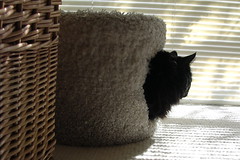
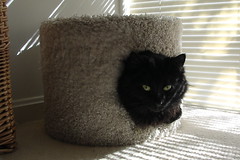
Tags: pets
Posted by barb on Mar 13, 2005 in
Science Musings Well, Pluto is actually as old as our Solar Systemr, but the official announcement of the discovery of Pluto by Clyde Tombaugh was made 75 years ago today, on March 13, 1930. Space.com has an article about Pluto and its discovery.
Pluto is the planet we know the least about, partly because it is the most distant planet (at least most of the time) and the smallest. It is also the only planet that has not had a spacecraft fly-by. Hopefully that will change in the next few years.
NASA‘s New Horizon’s Pluto-Kuiper Belt Mission is scheduled to launch in January 2006, and will arrive at Pluto sometime in 2010 after a 2007 fly-by of Jupiter for a gravity-assist.
Tags: science